
City guides
From Pickle Barrels to Small Batches: Philadelphia’s Pickle Revival




Mike Sicinski, Niki Toscani and their son. Image: Gab Bonghi. Photo courtesy of Fishtown Pickle Project.
Philadelphia’s love affair with pickles goes back much further than the jars lining today’s farmers market tables and specialty food shops. For generations, pickling was a practical way to preserve the harvest, a tradition carried to the city by immigrant communities, and eventually a thriving local industry. Today, a new generation of Philadelphia pickle makers is putting its own spin on that history, pairing old-school preservation methods with inventive flavors, local ingredients and a focus on sustainability.
Pickles Arrive in the New World
Pickling is one of the world’s oldest methods of food preservation, with evidence of vegetables being preserved in brine dating back to around 2400 B.C. Long before refrigeration, pickling allowed people to extend the life of seasonal harvests and preserve food for winter, long journeys, and periods of scarcity. Over centuries, cultures around the world developed their own methods and traditions using salt, fermentation, and, later, vinegar. Pickled foods also became especially valuable on long sea voyages; Amerigo Vespucci is often credited with bringing pickled vegetables to the New World in the late 15th century.
In Colonial Philadelphia, pickling was a necessity for preserving fruits, vegetables, nuts, meats and fish. It also offered a health benefit: the salt or vinegar in a brine worked to kill or inhibit the growth of bacteria and mold.
Pickling became an even more visible part of Philadelphia’s food culture with the arrival of Eastern European Jewish immigrants in the 19th century. For centuries, Jewish communities in Eastern Europe had relied on pickling to preserve cucumbers and other vegetables through long, freezing winters. When they settled in Philadelphia, they brought those traditions with them, along with other preserved foods, including corned beef and pastrami. Neighborhood delis became gathering places, with huge wooden barrels of pickles offering immigrants an inexpensive and familiar taste of the Old Country.
As Philadelphia’s immigrant communities grew, pickling also became a commercial enterprise. By the late 19th and early 20th centuries, South Kensington and Fishtown were home to several pickle factories, often located near the barrel warehouses that supported the industry. Before glass jars became commonplace, pickles were cured, stored, and transported in large wooden brine barrels.
That connection could be seen at Front and Palmer Streets, where the H. Siemon & Sons Barrel Factory operated adjacent to a pickle processing plant. The original wood and timber barrel factory was eventually replaced in the 1920s by a massive brick and steel structure built to increase production.
But Philadelphia’s barrel-pickle tradition never disappeared entirely. At Reading Terminal Market, Beiler’s Pickle Patch continues to sell barrel pickles alongside traditional Pennsylvania Dutch foods. Operated by the same multigenerational Pennsylvania Dutch family behind Beiler’s other market stands, it offers a living connection to the preservation traditions that predate today’s small-batch pickle revival.
Philadelphia’s pickle business wasn’t limited to large factories. Shupack Pickle Products Company, one of the city’s early kosher pickle companies, got its start with a pushcart in South Philadelphia in the early 1900s before growing into a larger operation.
By the mid-to-late 20th century, however, the industry was changing. The traditional barrel pickle declined as consumers increasingly turned to the convenience of pickles sold in glass jars and the industry became more consolidated. Shupack was eventually acquired by Vlasic, which later became part of Campbell Soup Co.
The Philly Pickle Boom: A New Generation of Philadelphia Pickle Makers
While Philadelphia’s large-scale pickle industry may have faded, the city’s appetite for pickles certainly hasn’t. Today, a new generation of local makers is putting its own spin on the tradition, from Fishtown to South Philadelphia, pairing old-school preservation methods with inventive flavors, local ingredients, and a renewed interest in small-batch production.
Fishtown Pickle Project started when chef Mike Sicinski and dietitian Niki Toscani gave handcrafted pickles to guests at their 2018 wedding. The enthusiastic response motivated them to launch a side gig that soon turned into a full-time business.
They tested the waters at the first Pickledelphia in 2018, a gathering of 1,500 pickle enthusiasts in Northern Liberties. Now, they process 3,000 pounds of cucumbers each week in the Globe Dye Works building in Frankford. Using all-natural ingredients, they sell pickles online and in 140 stores throughout the region, including Di Bruno Bros., Kismet Bagels, MilkBoy and Riverwards Produce.
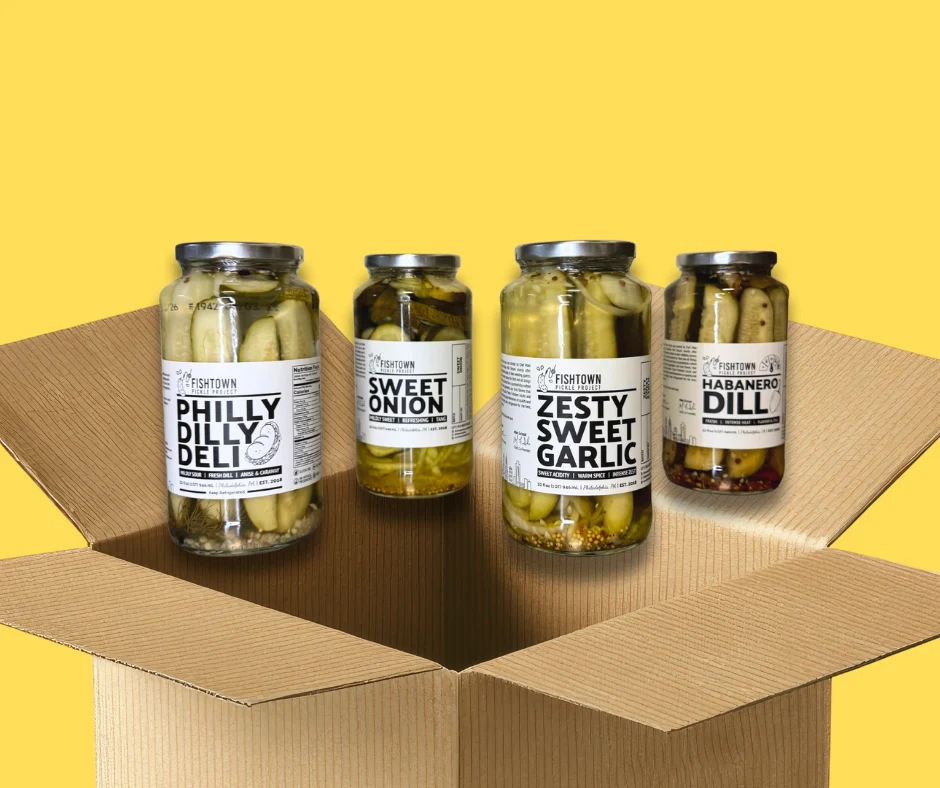
“We use traditional pickling methods with bold and innovative flavors,” said Toscani. For those who like it hot, they offer Habanero Dill and Preston’s Picks, which combine mildly hot banana peppers and sweet onions. Got a sweet tooth? Try their Sweet Onion Pickles, Zesty Sweet Garlic Pickles or Ginger Lemonade Pickles. Sour fans can choose between Original Sour, Philly Dilly Deli and Philly Dilly Relish. For cocktail fans, they also offer Dilly Bloody Mary Pickles.
“The difference between our Original Sour and Philly Dilly Deli is the brine. The Philly Dilly Deli is balanced with white vinegar, apple cider vinegar, salt, sugar, and spices, including dill. The Original Sour consists of more vinegar than water in the brine and does not contain dill. It packs more of a punch for those looking for big sour flavor,” said Toscani.
Philadelphia Pickle Company recently opened on East Passyunk Avenue, marking a homecoming for its South Philly-born founder, who previously spent a decade building a pickle business in Lancaster. The shop brings small-batch pickle-making back to a neighborhood known for its food traditions, with Philly-inspired varieties including Broad Street Krinkle Dill, South Philly Sweet Heat, Passyunk Garlic Smash and Rowhome Relish.
Philadelphia’s current pickle scene also includes makers like Penny Pickles, which cold-cures everything from classic cucumbers to other fruits and vegetables using locally sourced ingredients, and PickleDude, a pop-up vendor bringing its jars to farmers markets, fitness events and gatherings around Greater Philadelphia. Together with Fishtown Pickle Project and the newly opened Philadelphia Pickle Company in South Philly, they suggest that the city’s long relationship with the pickle is far from over.
Beyond the Pickle Jar
For Philadelphia’s new generation of pickle makers, the revival isn’t just about what goes into the jar. Local sourcing, reducing waste, and finding creative ways to reuse everything from leftover brine to empty containers are also part of the equation.
When the pickles are gone, Toscani recommends putting Fishtown Pickle Project’s leftover brine to work in marinades and dressings. That emphasis on reducing waste is part of Fishtown Pickle Project’s broader commitment to sustainability. “Our business emphasizes wellness, sustainability, and community engagement. We package our pickles in glass jars for sustainability reasons, and we educate people on how to reuse brines and spices to reduce waste,” said Toscani.
Local sourcing is part of that approach, too. “We use fresh, local produce. During cucumber season, we source directly from Muzzarelli Farm in South Jersey, a solar-powered, non-GMO, and family-owned business,” said Sicinski.
Fishtown Pickle Project also takes back empty jars at farmers’ markets and pickling classes for reuse and partners with Bottle Underground to help keep glass in circulation. Jars that can’t be reused can be transformed into new glassware or glass sand used in conservation projects. Even the company’s shipping boxes are fully recyclable.
Want to get into a pickle? Fishtown Pickle Project hosts pickling workshops and an annual “Feast of the Seven Pickles” dinner—a charitable event showcasing creative pickling beyond cucumbers.
The Big Dill 2026, the world’s largest pickle party, comes to town November 15th, National Pickle Day, at Stateside, 1100 Pattison Ave. Bring your appetite and the kids to sample pickles and eat them in ways you never imagined, including on pizza. There will be games, live music and a Pickle Rodeo featuring a mechanical pickle you can ride (till you fall off). Tickets go on sale Sept. 15th and quickly sell out.
In some ways, Philadelphia’s pickle story has come full circle. What began as a practical way to preserve the harvest became an immigrant food tradition, a neighborhood industry and, eventually, a mass-produced supermarket staple. Today’s local pickle makers are bringing the craft back to a smaller scale, with local ingredients, creative flavors and many of the same values of preservation and resourcefulness that started it all.
Philadelphia is full of small businesses finding new ways to carry the city’s traditions forward while thinking differently about what, and how, we consume. Meet more of the local makers we’ve featured on the Solo Real Estate blog, including Shane Confectionery, where historic candy-making traditions have been introduced to a new generation, and STITCH AND DESTROY, a South Street studio turning textile waste into one-of-a-kind clothing.