City guides
Exploring the Wissahickon



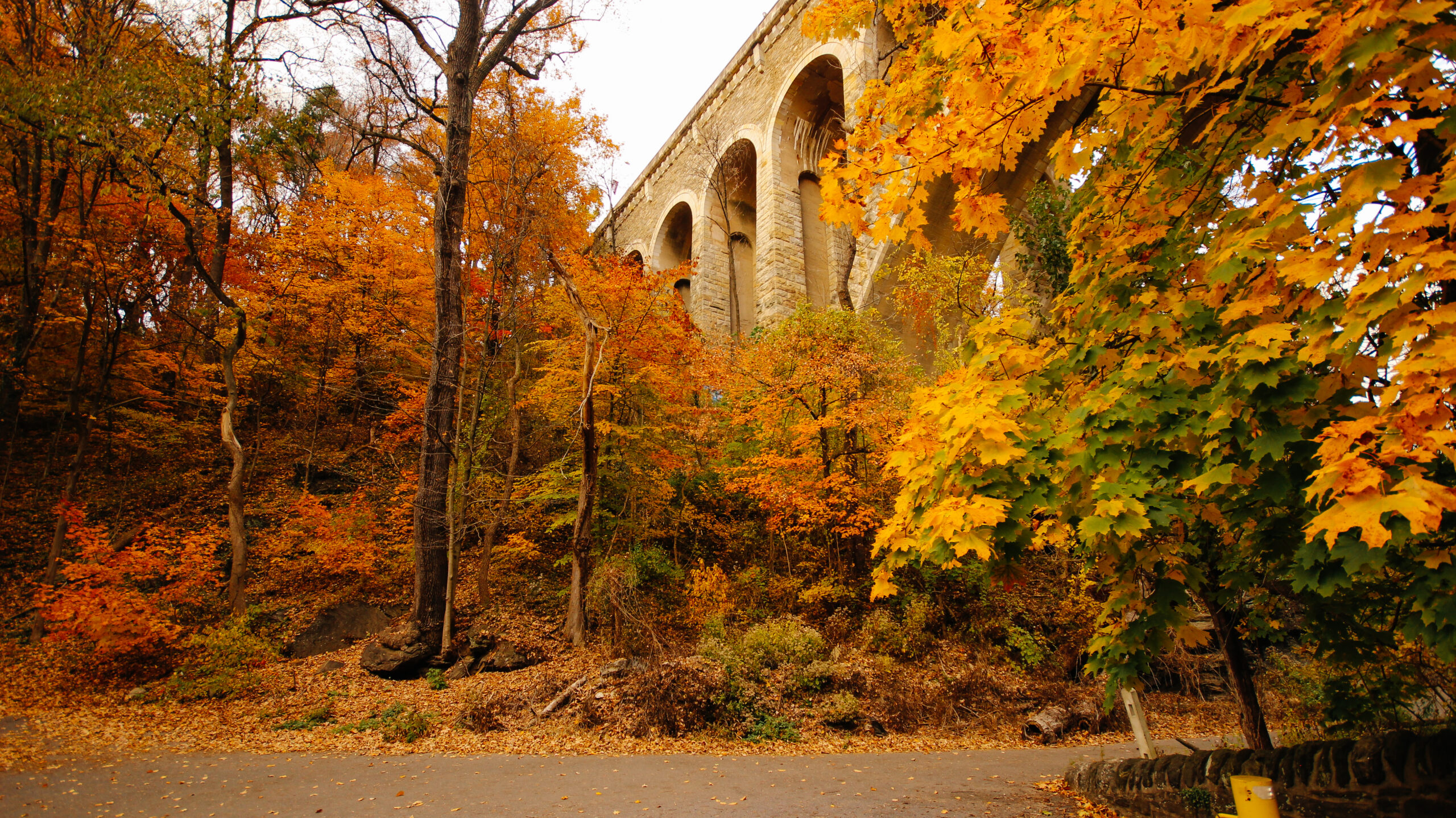
Wissahickon Trail during the fall season. Image: Cory J Popp.
You may think you know Fairmount Park, but to really appreciate it, you have to spend a day in Wissahickon Valley Park. Each year, this 2,000-acre forested gorge draws over one million visitors with its year-round offerings: hiking, biking, birding, fishing, cross-country skiing, horseback riding and a spectacular fall foliage display. Known by locals simply as the “Wissahickon,” the park is a National Natural Landmark located in Northwest Philadelphia, adjacent to Germantown, Mt. Airy and Chestnut Hill. To fully appreciate this natural habitat’s role in Philadelphia’s development, we have to go back to the Wissahickon’s original stewards, the Lenape.
In the Beginning
Geologists tell us that the Wissahickon was a pristine wilderness until the Lenape arrived 2,000 years before European colonization. They hunted, fished, trapped, and farmed in the area until they were pushed westward in 1750. Now, over 275 years later, we continue to use the name “Wissahickon,” which comes from the Lenape word wisameckhan for “catfish creek.”
To the Lenape, conservation of the Wissahickon was a sacred duty. They practiced active, sustainable stewardship, using controlled burns to create meadows, enhance wildlife habitats, and protect essential trees. When colonists arrived, they viewed Wissahickon Creek as a business venture, using it to power over 50 industrial mills producing lumber, paper and textiles, with little thought to the impact on plants, wildlife or people. Since the creek is a tributary of the Schuylkill River, the City of Philadelphia acquired and removed these mills in the 1870s to protect the public water supply, transforming the valley into Wissahickon Valley Park, an official part of Fairmount Park.
Around the same time, wealthy developer and railroad executive Henry Houston brought the Pennsylvania Railroad to Chestnut Hill and turned farmland into an upscale summer retreat for Philadelphia’s elite. Fortunately, Houston had a deep appreciation for nature and helped expand and preserve Wissahickon Valley Park.
Historic Bridges
While many of the Wissahickon’s historic wooden bridges have long since been demolished or destroyed by floods, several remaining bridges are worthy of attention. The Hermit Lane Bridge and the 1931 Henry Avenue Bridge (also known as the Wissahickon Memorial Bridge) are excellent examples of local fieldstone and concrete bridges built between 1794 and 1931. The Walnut Lane Bridge is one of the first reinforced concrete bridges ever built. The center arch made it the highest and longest concrete arch bridge in the world when it opened in 1908.
The Fingerspan Bridge, which serves as a footbridge for hikers, is actually an art installation created by local artist Jodi Pinto in 1987. The Thomas Mill Covered Bridge, built in 1737 and restored in 1855, is the only surviving covered bridge in Philadelphia. It spans 86.5 feet over Wissahickon Creek adjacent to Forbidden Drive inside Wissahickon Valley Park. It is also the last historic covered bridge left standing in any major U.S. city, which helps account for its status as one of the most photographed locations in the Wissahickon.
Preservation & Conservation
Today, Friends of the Wissahickon (FOW), a member and volunteer organization, plays a vital role in maintaining the park’s ecosystem and encouraging public involvement. The organization hosts photo contests, hiking events, runs, birding walks, picnics and cleanups. Last year, FOW staff and volunteers removed 16 tons of trash from the park!
But perhaps its most important work honors the Wissahickon’s original caretakers, the Lenape. In 2002, when the Lenape Nation of Pennsylvania launched The Rising Nation River Journey in response to pollution in the Delaware River, FOW was among the first signers and has continued a close partnership with the Lenape Nation. This renewed friendship acknowledges the Lenape Nation as stewards of their ancestral homeland.
A Park for All Seasons
Every season of the year is the “best” time to visit the Wissahickon. In the fall, when the trees are awash with dazzling color and crisp autumn leaves cover the trails, wander along scenic Forbidden Drive, the park’s five-mile, flat gravel trail that follows the creek, passing a covered bridge, waterfalls, and the Valley Green Inn, where guests can stop to enjoy brunch, lunch or dinner.
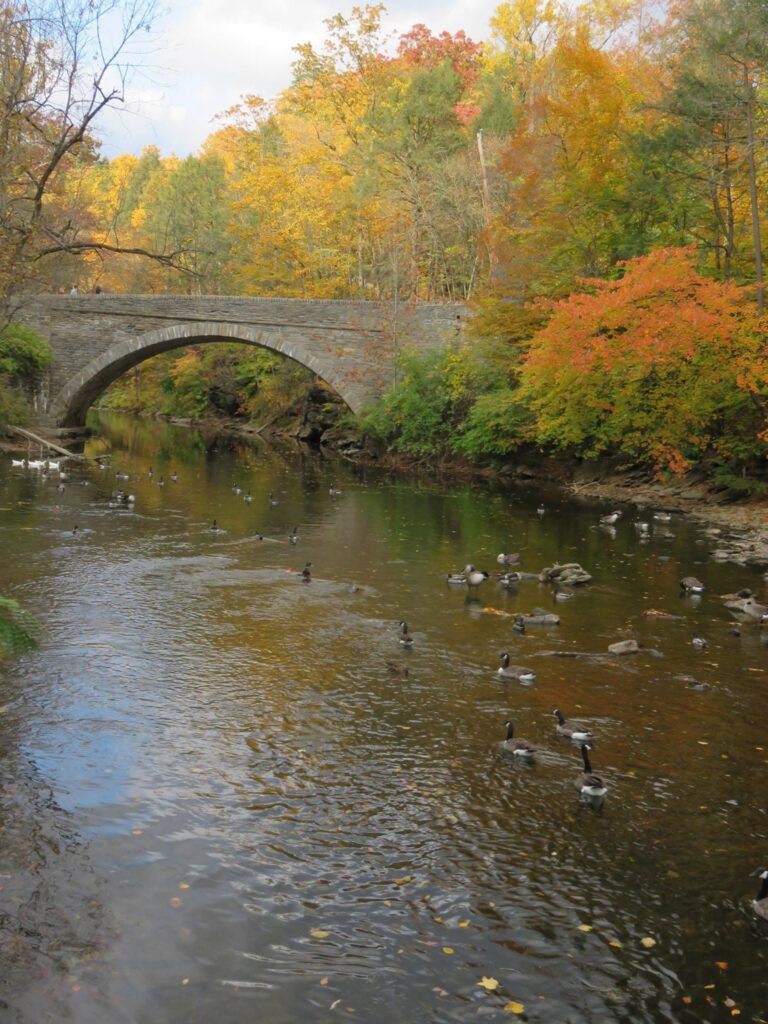
The Inn, built in 1850, was originally called the Temperance Tavern and is the last of the remaining roadhouses and taverns along the Wissahickon. Friends of the Wissahickon has been the guardian of the Inn since 1934 and saved it from demolition. It’s also a favorite spot to relax on a bench overlooking the creek and watch ducks and geese. For the more adventurous, there are hiking and biking trails of varying difficulty. Or try to locate the fifteen-foot marble statue of Lenape leader Chief Tedyuscung, staring down from atop a cliff.
Winter turns the Wissahickon into a frosted storybook landscape, where you are likely to find cross-country skiers and horses pulling sleighs with jingle bells. While the trails may be too taxing this time of year for tiny lap dogs, they’re sheer heaven for larger breeds. Spring brings out birders, fishermen, joggers trying to run off their winter indulgences, families with cabin fever and, of course, lovers. This is where young couples share their first kiss and propose. Few places in Philly are as romantic, which is why the Valley Green Inn is a popular wedding venue.
Summer is a special delight because the temperature in the Wissahickon can be cooler than outside the park and “everyone” is at the Shore. While weekends can still be crowded, weekdays are generally much quieter. This is an especially nice time for family bike outings along the deeply shaded Forbidden Drive. While teens may flaunt posted warnings and jump off the cliffs into the creek at Devil’s Pool, swimming is not permitted. Regardless of the season, the Wissahickon is always a photographer’s and artist’s paradise, offering a captivating panorama from sunup until dusk, when the park closes.
Adjacent Neighborhoods
Wissahickon Valley Park is bordered by Germantown, Mt. Airy and Chestnut Hill, three historic Northwest Philadelphia neighborhoods worth exploring before or after your visit. From the shops and restaurants of Chestnut Hill to Mt. Airy’s community hubs and Germantown’s rich architectural history, each offers plenty to discover beyond the park. For a closer look at the area, visit our previous blog, Neighborhood Walking Tour: Germantown.
How to Get There
Whether you bike or drive to Wissahickon Valley Park, take the scenic route via Kelly or MLK Drive to Lincoln Drive. This lets you stay within Fairmount Park for the entire journey! You may enter the park from Historic Rittenhouse Town, 6034 Wissahickon Avenue, or find free parking via Bells Mill Road at 9598-9500 Forbidden Drive.
For the largest free parking area, we recommend Northwestern Avenue between Germantown Avenue and Forbidden Drive, which places you at the start of the trail with easy access to trail maps and restrooms. For landmarks, look for Chestnut Hill College and Bruno’s, a popular breakfast and lunch spot, at Germantown and Northwestern Avenues.