

featured business
Featured Business: The Weaving Circle




All Images by Leah Franqui.
When it comes to sustainability and local businesses, we Philadelphians know that sometimes, despite the pressure to find futuristic solutions, we have to look to the past for our best, most ecological, and human-centered practices. In the wake of fast fashion and the rise of artificial intelligence, many are hungry, and justifiably so, for a return to slow fashion, an appreciation for craft, and a renewed valuation of human makership. Just as the Arts and Crafts movement was a reaction to industrialization and mechanization, so too are modern maker movements a space for us to reorient ourselves around material culture and what we value.
And nowhere is material culture more on display than in the creation of fabric, aka material material culture, that is. It is this spirit of appreciation for art, craft techniques, sustainability in both mindset and action, and Philadelphia makership that textile and visual artists and teachers Melissa Terrels and Stephanie Gleit have embraced in founding The Weaving Circle, a new weaving center in the historic University of the Arts building at Pine and South streets, recently renamed the Village of Industry and Art.
Both artists have long worked in the field of textile art. Terrels has been weaving since college, with an educational background in fiber and art. “Everything about weaving attracts me, compels me,” Terrels comments. “Texture, pattern, color, it satisfies everything I’m drawn to. The tactility feels essential, and it’s infinite, you can never exhaust the possibilities of weaving patterns and combinations.”
Spinning and knitting joined weaving as part of her practice, though she put them on pause for a while. It wasn’t until she moved to Philadelphia from the suburbs as an empty nester that she found the space in her life to focus on weaving full time.

Gleit, a third-generation Philadelphian, has a background in fine arts and printmaking, but when she encountered weaving after completing her MFA, she fell in love. Raising a family and working as an artist and graphic designer put her textile art on the back burner, but the combination of COVID and having children in school allowed her to return to weaving. She recently began pursuing her textile art full time.
Gleit’s adoration of the work aligns deeply with Terrels’, as she notes, “It’s an endless combination of weaving and what you bring to it, it means endless lifelong learning. You can’t get bored!”
After the closure of Weaver House last year, Terrels and Gleit, who had known each other through the local fiber arts community and crossed paths at craft shows and events for years, mourned the gap its closure left in Philadelphia’s creative ecosystem. Then they decided to do something about it.
When a space opened up in the Village of Industry and Art, a women-led, community-driven collective reimagining the historic building in the wake of the UArts closure, it felt like kismet.
“We knew they support their artists here,” Gleit said. “It built a community for us right away.”
Being in the building has been a dream for Gleit and Terrels because it so deeply reflects the values they’ve infused into their business. It’s also in Philadelphia itself, unlike many other spaces for fiber work, which are a little further afield.
“There was nothing in Center City, everything was out of the city!”

Historically, spinning and weaving in the Western world have often provided women with opportunities not only to clothe their families but also to earn an income, express themselves creatively, and find community through making. Industrialization transformed women’s relationship to textile production, shifting much of the work from homes and independent workshops into factories. Consider the shift in meaning of the word spinster, which originally referred to a woman who spun yarn, a trade that could provide a source of income, before becoming a term for an unmarried woman, eventually acquiring derogatory connotations.
The relationship between women and textile crafts has long been complicated. While second-wave feminism challenged the restrictive expectations of domestic life, feminist artists also reclaimed traditionally feminine crafts, from quilting to embroidery, as legitimate forms of artistic expression. Today, textile artists like Terrels and Gleit continue that tradition, not only expressing their phenomenal talents in fiber but creating space for people of all genders to reclaim craft as an empowering and sustainable practice.

Moreover, they are following in the proud tradition of American women who used textile work to contribute to the Revolution, from women producing homespun cloth in defiance of British imports to Philadelphia upholsterer Betsy Ross. Then there’s the local legend of Molly “Mom” Rinker, who supposedly concealed secret messages in balls of yarn and dropped them to patriot supporters from a rock overlooking the Wissahickon. It’s a story that connects Philadelphia’s textile traditions to its revolutionary past, even if the details remain the stuff of folklore.


For both Gleit and Terrels, weaving as a personal practice and something to share with others is a deeply vital act.
“The loss of knowledge of this craft kills me,” Gleit comments. “This work is about keeping weaving alive, about building a community around weaving and fiber, not just teaching.”
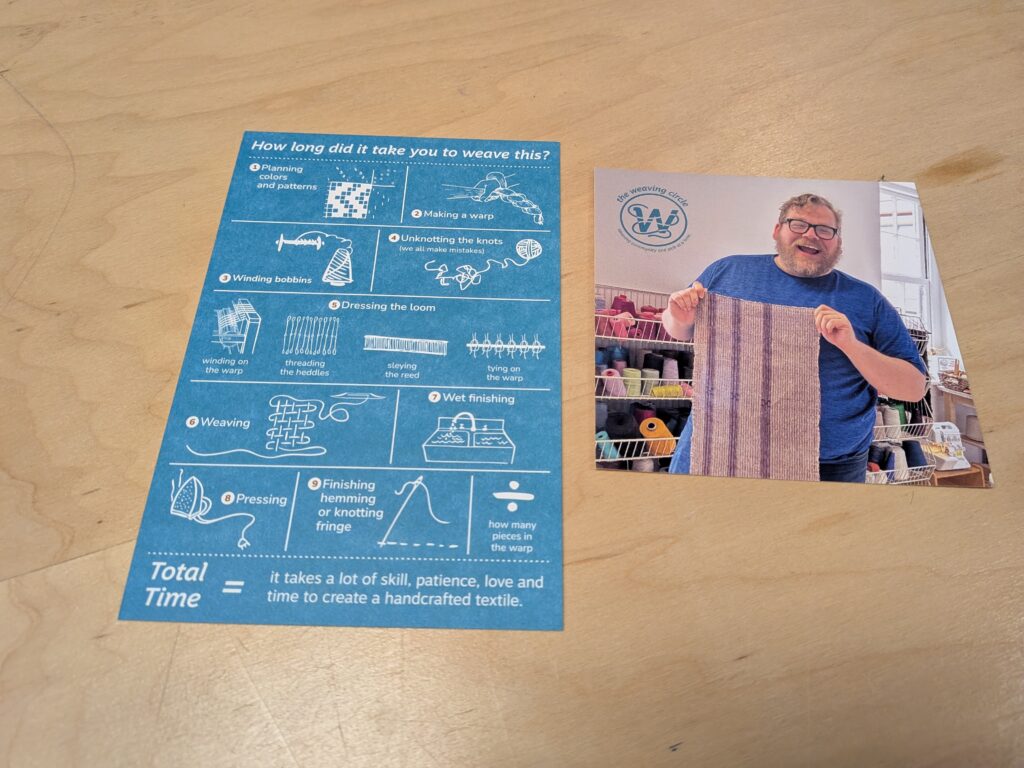
There is also something essential for both women in how sharing weaving helps people understand just how complicated and labor-intensive the work is. They hope this understanding prompts a greater appreciation for the labor and resources that go into every garment we wear, handwoven or not.
“You don’t come in here and learn how to weave in two hours,” Terrels notes when describing one of their most popular offerings, the Walk In And Weave Class. “You experience the act of weaving, but you don’t learn it all.”
Terrels describes preparing the loom, arranging the elements of the weaving process, and removing the cloth from the loom, all steps that add to the work of fabric creation. But even without completing every step, Gleit and Terrels know that participants can gain a deeper appreciation of the work of making fabric, as well as its joy.
“How do we combat the lack of value people have for fabric, for material culture?”
The process, they hope, is the way.
“The accomplishment people feel in saying I made it can’t be overstated,” Gleit reminds us. “It teaches people to love the process, and to appreciate the work, to even want less stuff. Less is more is a big part of the textile process.”
While the Walk In And Weave Class is probably how many first encounter The Weaving Circle, there are plenty of other offerings for fiber enthusiasts and novices alike. A variety of weaving classes cover more of the process, including dressing the loom, design planning, winding the warp, and individual weaving instruction.
In addition to their retail space, which features supplies and some of the gorgeous pieces created by Gleit’s and Terrels’ masterful hands, The Weaving Circle offers spinning classes, with plans to expand these offerings in the future.
The pair also have collaborations planned with Butcher’s Sew Shop, where students will be able to take fabric created in one of their weaving classes and transform it into something new through a sewing class at Butcher’s, expanding their understanding of the making process.
They have plans to develop a yarn line for weaving, as well as visions of bringing in university students, because even at many prestigious art schools in the area, students have little or no access to weaving and fiber arts. They also hope to invite natural dye experts and other fiber artists to instruct and share their knowledge.


The Weaving Circle hosts free weekly open studio sessions on Thursday evenings “for makers of every stripe,” creating opportunities for community engagement, the exchange of craft knowledge, and the kind of physical space for connection and togetherness that is so lacking for many of us today.
“Our goal is to enlarge this and bring it to more people, so they can actually rent out this space for their students, and we’re closer to that than we thought we would be by this time,” Terrels underlines.
As a business, The Weaving Circle faces a few challenges beyond the modern consumer’s limited understanding of craft culture. Being in a space that doesn’t look like a traditional retail storefront can be tricky, but luckily, places like the Bok Building have paved the way for studios with designated open hours and retail spaces that require a little exploration to discover.

“It was so interesting to see all these people coming to the open studios who didn’t know anything, had never seen a piece of equipment for weaving, to see their reactions, and to tell them, ‘ That’s how your clothes are made, just bigger!” Terrels comments.
The Weaving Circle also benefits enormously from the supportive community within the Village of Industry and Art. Beyond the open studio days the building recently hosted, the Village will hold a Fiber Festival on December 5 in conjunction with PA Fibershed, a non-profit organization co-founded by Leslie Davidson, a former Solo tenant.
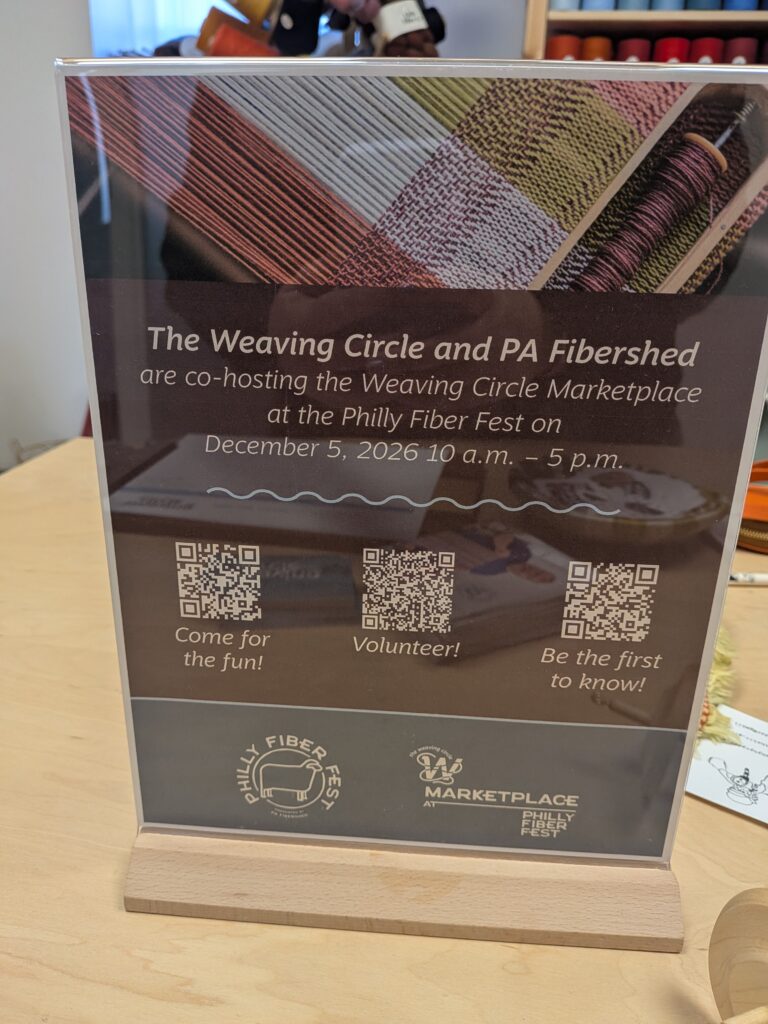

The festival will feature weaving demonstrations, opportunities to try weaving and spinning, workshops, fiber art and supply vendors, and children’s activities. It promises to be an incredible opportunity to experience this world of making firsthand, talk to artists, and, of course, pick up some gorgeous handwoven pieces created right here in Philadelphia by local makers, just in time for the holiday season.

“It’s all of this rolled into one; it’s dirt to shirt, sheep to shawl. You can see every step of how things are made. We’re going to have workshops, spinners, an art gallery with local artists, local vendors, so people can see the whole process.”
“We want to bring the value of makership into the community. At its heart, art is just problem solving, looking at something from a lot of angles, imagining the solutions to a problem and creating them. We want to make a space for people to celebrate that here. People don’t know what weaving even is, they don’t know to look it up, they don’t know. We want to tell people: this is the thing you never knew you needed,” Terrels says.
“It’s not as run-of-the-mill as a painting class, but it can still be accessible. There is this perception that you need this massive equipment to do this. We want to make this accessible, to demystify this process for people,” Gleit describes. “Get off your phone, bring a friend, bring your mom, bring your dad. Get analog with us.”
“In a digital world, the physicality, the tactility, and the accomplishment of saying I made this, that’s something I grew up always hearing. You don’t hear that anymore. It’s so beautiful. We want to bring that back,” Terrels says
“And they say it every time,” Gleit says about their students. “Every time. That’s the joy.”


