
philadelphia history
Neighborhood Histories: East Falls




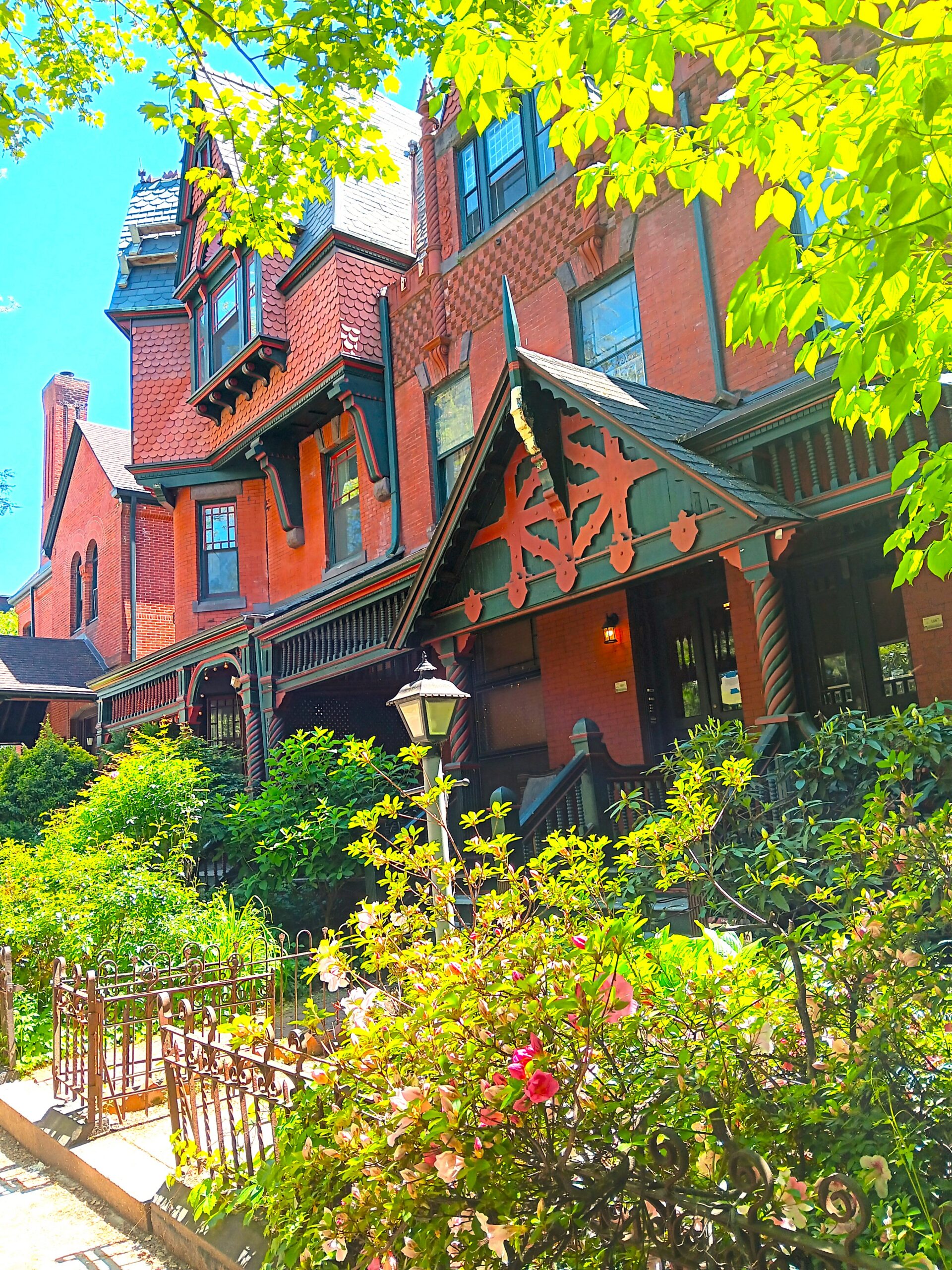
Tudor Revival Houses in East Falls. Image: Steven Peitzman
East Falls is a neighborhood of contrasts. A bucolic refuge of Gilded Age estates, an industrial boom town, and a treasure trove of architecture from Renaissance Revival to Mid-Century Modern. It was the home of the Lenni Lenape, colonial farmers, captains of industry, Irish immigrants, and freed slaves. Even a princess.

Originally known as the Falls of the Schuylkill, East Falls is bordered by the Schuylkill River, Wissahickon Avenue, Hunting Park Avenue, and Lincoln Drive. It takes its name from the waterfalls that created rapids under what is now the Falls Bridge, making navigation dicey. In 1822, the Fairmount Dam raised the river’s level and neutralized the falls. Along with the construction ofthe Schuylkill Canal in 1825, this turned sleepy East Falls into an industrial powerhouse.

19th Century Industrialization
Among the first to seize on the potential of the area were two English brothers, John and James Dobson. In 1858, they established Dobson Mills, one of the largest textile mills in the nation. (Yes, larger and older than any textile mill in Kensington!) They made blankets for the Union Army and were renowned for wool yarn and carpets. Originally located at Ridge Ave and Wissahickon Creek, they moved to Ridge and Scotts Lane in 1872, where they built a massive industrial village of 19 buildings spread over 26 acres. To house employees, John Dobson bought up land and built thousands of worker cottages in the hilly section of East Falls, which continues to give the neighborhood its character.

In 1860, John Dobson built several grand mansions for himself, including the opulent Bella Vista, with sunken gardens. The only one that still stands is Hohenadel House, 3722 Indian Queen Lane. Today, Dobson Mills is a historic district known as Sherman Mills, 3502 Scotts Lane, which was redeveloped in 2001 as a complex of apartments, offices, and shops.

Not long after the Dobsons arrived, Powers and Weightman, a prominent 19th-century American chemical manufacturing firm, relocated from Center City to East Falls. They produced quinine and became one of the largest chemical manufacturers in the world. Accordingly, William Weightman, the “Quinine King,” became one of the wealthiest men in America. In addition to his residence at 1724 Walnut St., Weightman commissioned Willis G. Hale to design Ravenhill, a Renaissance Revival mansion located on 27 acres in East Falls in 1887.


Not all East Falls estates were built for their proximity to their owners’ place of business. In 1886, retail magnate Justice C. Strawbridge, whose department store was on Market Street, purchased 30 acres overlooking Fairmount Park. He called his estate Tortworth. In 1925, the Strawbridge estate was converted into Alden Park Manor, 5500 Wissahickon Avenue, a luxury Art Deco complex with three high-rise apartment buildings in the Jacobean and Stuart style, known for its sunken gardens and ornate indoor swimming pool. Surviving Strawbridge Estate structures, like the 1905 Francis R. Strawbridge House, 5710 Wissahickon Avenue, and nearby Gothic Revival villas on Oak Rd, are typical of the grand estates that once defined the area. In 1970, Alden Park Manor became Alden Park Apartments and shifted from long-term affluent tenants, including Grace Kelley’s mother, to college students and retirees.


20th Century Architecture
The early 1900s brought a wider range of architectural styles to East Falls, along with middle-class housing developments. One of the most attractive can be found in the Tudor East Falls Historic District, featuring 210 Tudor Revival homes developed 1925-1931 on the 3400 blocks of Midvale Avenue, West Penn, and West Queen. They feature cathedral windows, 14′ beamed ceilings, wood-burning fireplaces, and French doors.
Grace Kelly‘s six-bedroom childhood home, 3901 Henry Ave., is a tourist attraction, especially for film buffs. It was built in Colonial Revival style by her father, John B. Kelly, Sr., in the late 1920s. Kelly Sr. started as a bricklayer and became a self-made millionaire with his own construction company, as well as an Olympic rowing champion. His daughter, Grace, attended Ravenhill Academy and became an Academy Award-winning movie star. In 1956, she astonished fans by retiring from films and marrying Prince Rainier of Monaco. In October 2016, Princess Grace Kelly’s son, Prince Albert of Monaco, bought his mother’s childhood home in East Falls and restored it to its original grandeur. It is not open to the public.

Mid-Century Modern fans will find a lot to love in East Falls. Hassrick House, 3033 Cherry Lane, is one of the few homes on the East Coast designed by Richard Neutra. Neutra’s signature walls of glass created a connection to the surrounding woodland. It is now part of Jefferson University’s Center for the Preservation of Modernism.
Philadelphia architect Earle Bolton Jr. designed what he called his Hollywood Rancher at 4200 Henry Avenue. It was later donated to the Philadelphia College of Textiles and renamed The Paley Design Center at Philadelphia University, now Jefferson University.
Sadly, the most important mid-century modern home in East Falls recently lost its bid for historic preservation and is scheduled for demolition. Designed by Elizabeth Fleisher, the first licensed woman architect in Philadelphia, it was built at 4030 Apalogen Road in 1954 in a unique enclave of midcentury modern homes on the former estate of a 19th-century textile manufacturer. Constructed of Valley Forge stone and Cypress wood, it was the home of Fleisher and her husband, noted landscape architect Horace Teller Fleisher. Fleisher is best known for designing the Parkway House in 1952.
Today, East Falls reads like a living architectural timeline, where industrial ambition, Gilded Age wealth, mid-century experimentation, and modern reinvention coexist within a few walkable blocks. From mill villages and mansion-lined avenues to Tudor streets and glass-walled modernist homes tucked into the woods, the neighborhood’s built environment tells a story of constant adaptation shaped by geography, industry, and changing ideas of home. Even as preservation battles continue and redevelopment reshapes familiar sites, East Falls remains defined by its layered history, one that rewards close attention and reminds us that Philadelphia’s past is never static, but something we continue to inhabit.
Special thanks to Steven Peitzman, President of the East Falls Historical Society, for contributing photos and information. For walking tours of the neighborhood, contact the East Falls Historical Society.