
philadelphia history
Neighborhood Histories: Spruce Hill



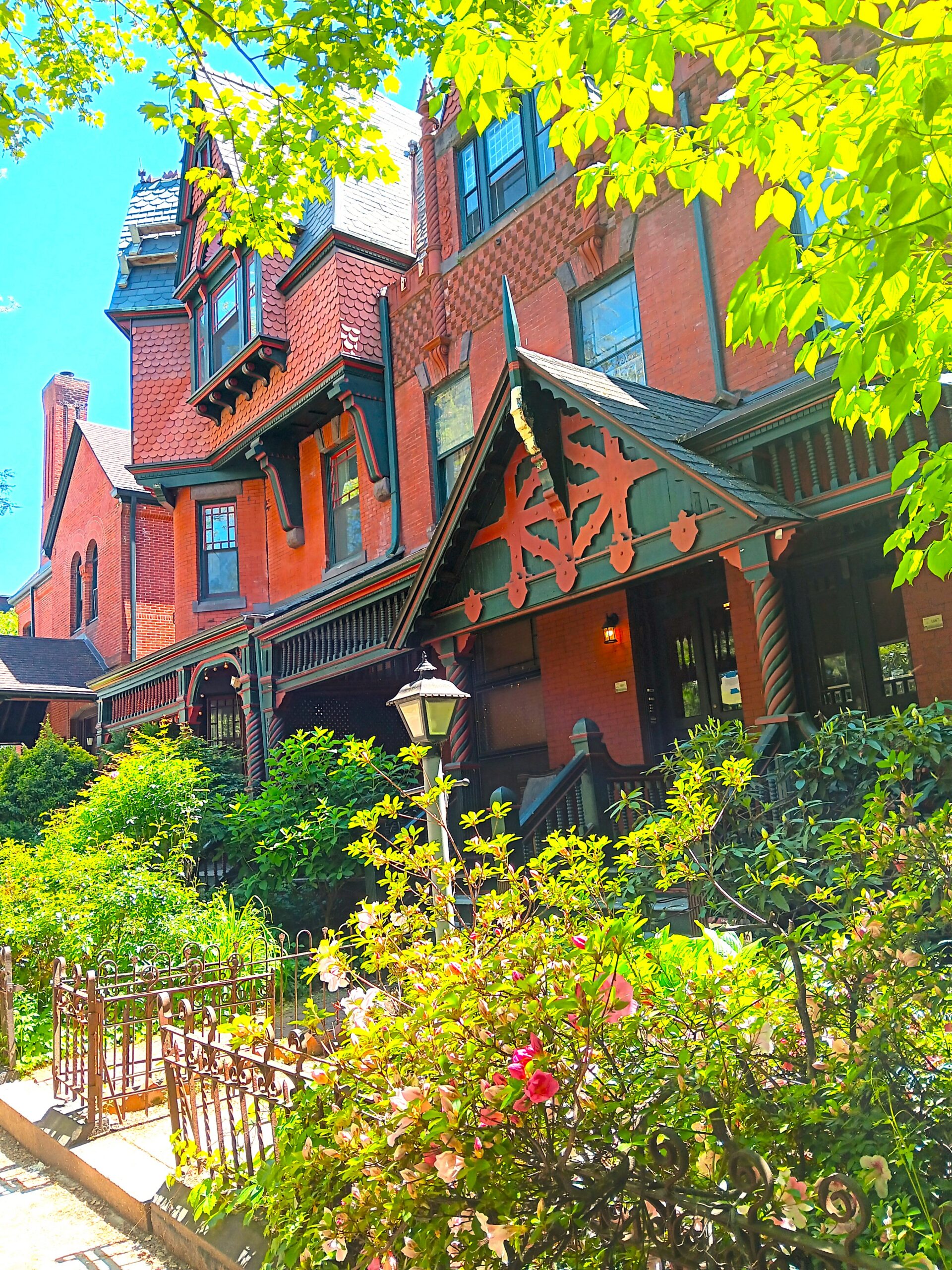
4200 Block of Spruce St. Image: Stacia Friedman
Spruce Hill is the sweet spot of University City in West Philadelphia, known for its historic Victorian architecture and vibrant, diverse community. Bordered by Market Street and Woodland Avenue between 40th and 49th Streets, the neighborhood first flourished not because of its proximity to the University, but because of the advent of horse-drawn trolley cars. For the first time, Philadelphians could commute downtown while living in the newly developing “suburb” of West Philadelphia. Between 1850 and 1910, residents were drawn to Spruce Hill’s spacious Queen Anne homes, leafy streets, and quieter pace of life.

From Farmland to a Streetcar Suburb
Before its development in the mid-19th century, Spruce Hill was largely rural, inhabited by a sparse population of farmers and wealthy landowners. They included William Hamilton, an architect and botanist who inherited hundreds of acres overlooking the Schuylkill and built a lavish 16-room Georgian mansion and arboretum. Now known as the Woodlands, a National Historic Landmark at 4000 Woodland Ave., it serves as a cemetery and an arboretum maintained by the University of Pennsylvania and the West Campus of St. Joseph’s University. It is also the headquarters of the Philadelphia Orchard Project. If you have an interest in horticulture and history, the Woodlands makes a delightful outing.

Image: Stacia Friedman.

In 1886, architects George and William Hewitt designed a group of Queen Anne houses between 4206-18 Spruce that are described as “the most distinguished block of late 19th-century houses in the city” in Philadelphia Architecture: A Guide to the City by former Preservation Alliance director John Gallery. The Hewitts, who also designed mansions in Chestnut Hill and Main Line, gave Spruce Hill a blend of Queen Anne with High Victorian flair. This included dramatic gables, a bold color scheme, and mixed materials not found in Center City townhouses and rowhouses. Also attributed to the Hewitt Brothers are the thirteen mid-19th century, red brick, Italianate row houses between Locust and Walnut streets, and 42nd and 43rd streets.
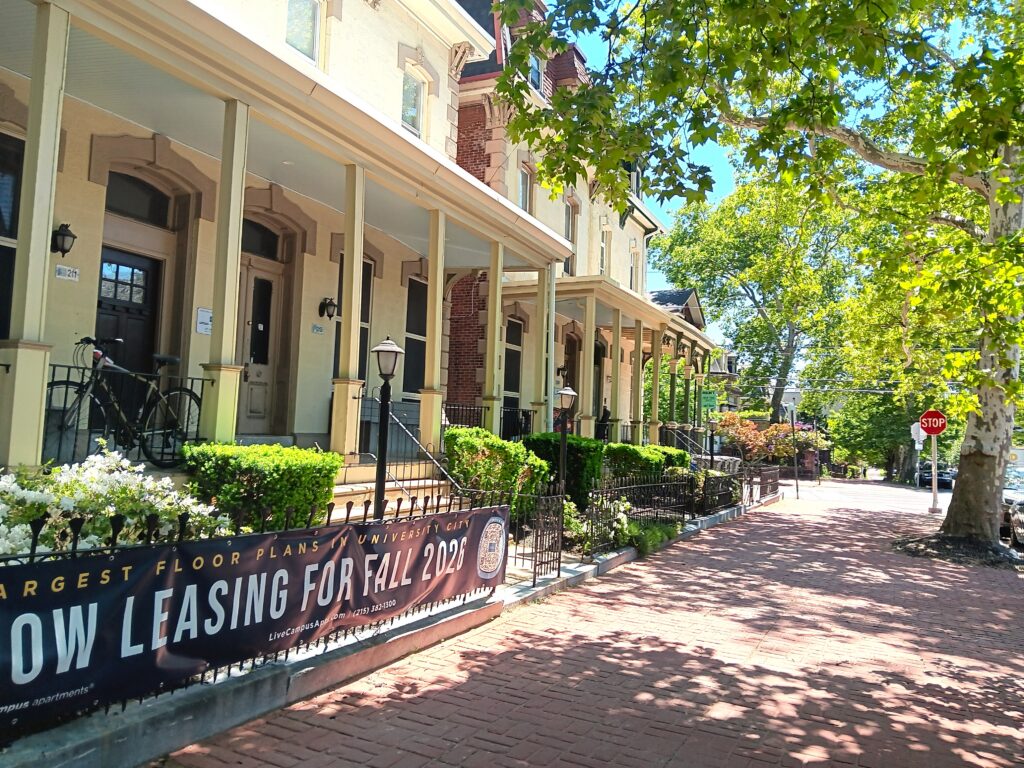
The neighborhood also includes Second Empire and Georgian Revival styles featuring large porches, bay windows, and decorative details. Another architect who added to the character of Spruce Hill is Charles S. Metzger. His fanciful Queen Anne house at 4232 Pine St., built in 1906, is one of nine homes he developed on Pine Street featuring semi-detached twins.
Anthony J. Drexel was significant in Spruce Hill history, not only as the founder of Drexel University, but also as an expansive property owner and developer. Following the Civil War, he built an ornate, 45-room Italianate mansion on a property bounded by 38th, 39th, Walnut, and Locust Streets – what is now a prime slice of Penn’s campus. Drexel also built mansions for two of his sons in the Queen Ann style. One mansion is now home to the Pi Phi Chapter of Sigma Chi fraternity; another now belongs to the Alpha Tau Omega. Drexel also owned undeveloped properties between Larchwood and Spruce Streets from 46th to north of 47th.
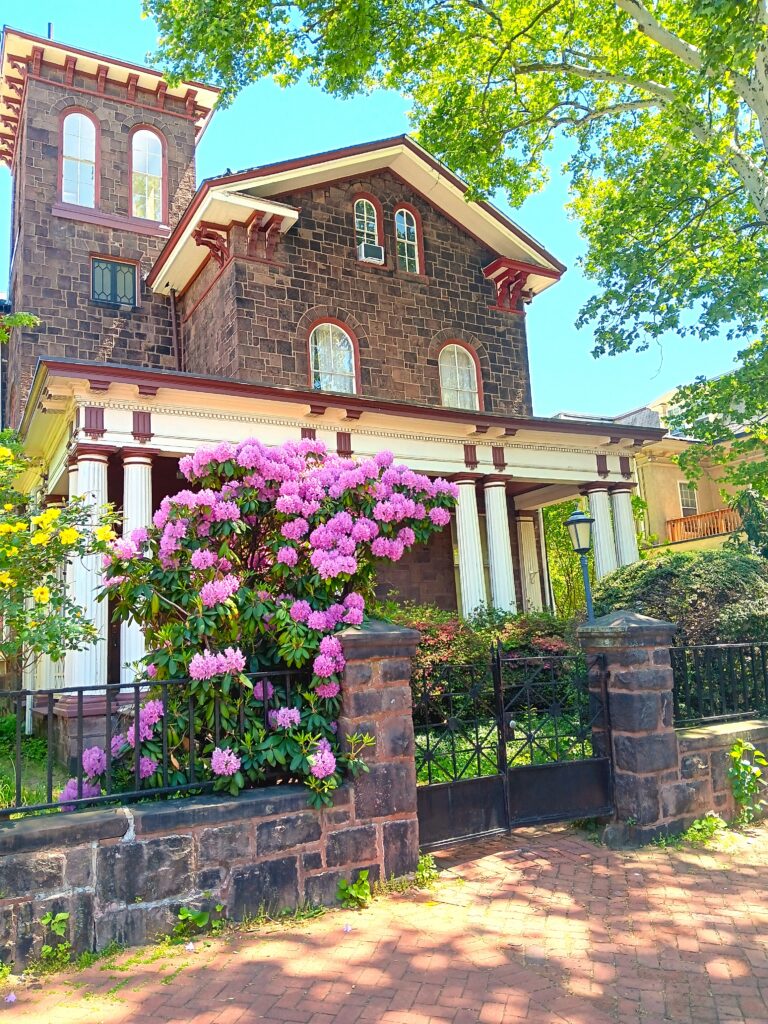
The biggest developer in Spruce Hill was financier Clarence Howard Clark, who built a grandiose 34-room mansion for himself named Chestnutwold at 4200 Locust Street. The three-story brownstone mansion had hand-carved mahogany paneling, stained glass windows, hand-painted wallpaper, a private art gallery, a library, and a hydraulic elevator. But don’t go looking for it. Chestnutwold was demolished in 1916 and, today, is the site of the Penn Alexander public elementary school. But you will find a perfect example of Victorian Gothic style at 4200 Spruce, built circa 1890, which was the home of Clark’s son, Clarence Howard Clark, Jr.
Clark’s most lasting gift to Spruce Hill was Clark Park, a public park with 9 acres containing 500 trees, bordered by 43rd and 45th streets, and by Baltimore and Woodland Avenues. This is where neighbors, students, and visitors gather for picnics, chess, live music, movie nights in August, and a year-round Saturday Farmers Market featuring seasonal produce, bakery goods, and food trucks. The park is also known for its historic Charles Dickens statue, cast in 1890, and has an annual event in February celebrating the author.
Renewal
In the 1990s, when University City experienced a rise in crime, Spruce Hill was considered less desirable until Penn made an effort to encourage faculty and staff to buy homes there by offering them zero-interest mortgages. They also improved the schools, public safety, and restored Clark Park. Since then, the area has become one of the most popular real estate markets in the City. In 2024, the Philadelphia Historical Commission voted unanimously to create the Southeast Spruce Hill Historic District, bounded by Spruce Street to the north, 39th Street to the east, Baltimore and Woodland Avenues to the south, and 43rd Street to the west.
Spruce Hill Summer Events
Spruce Hill’s strong sense of community is perhaps most visible during the neighborhood’s annual festivals and public events.
West Philly Porch Fest is a raucous afternoon of free live music, from Balkan to Brazilian, throughout Spruce Hill, on May 30th,12-6 pm. Check the website to see who is playing where. If you want to get a taste of the international flavor of this vibrant community, participate in the annual Baltimore Avenue Dollar Stroll, between 40th and 52nd, on Thursday, June 4th. Or, better yet, try some of Spruce Hill’s dining hot spots anytime. Sample award-winning Ethiopian cuisine at Doro Bet, Jamaican specialties at 48th Street Grille, or authentic Mexican dishes at Don Barriga. Over Memorial Day Weekend, raise a mug at Parks on Tap, May 20-25. Shakespeare in Clark Park Theatre Company presents Hamlet, July 29th-Aug. 2nd.
Solo Real Estate’s motto, “love where you live,” validates why so many have chosen to call this thriving, architecturally significant community home. With its remarkable architecture, walkable streets, cultural diversity, and enduring community spirit, it’s easy to understand why Spruce Hill remains one of Philadelphia’s most desirable neighborhoods. More than a historic district, it is a neighborhood that continues to thrive while honoring the character that made it special in the first place.