
philadelphia history
Lighting the Way to Energy Efficiency



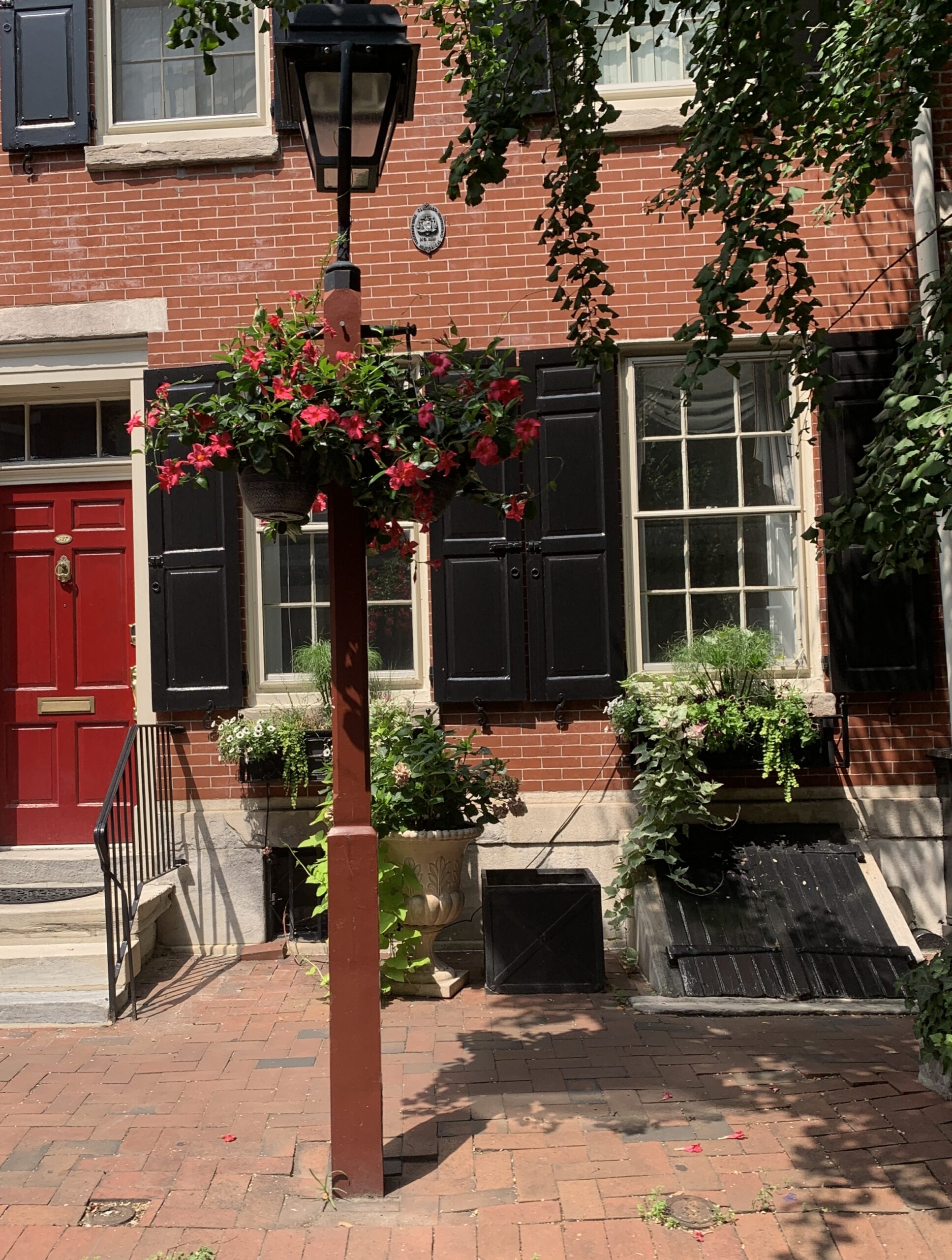
Philadelphia colonial rowhome with a flower basket on a lamp post. Image: Stephanie Aviles
The city of Philadelphia has long led the way in street lighting, from 18th-century oil lamps to today’s energy-saving LED lights. To better understand the financial, health, and environmental advancements in our City’s public lighting, we need to go back to the future.
Burning the Midnight Oil
If you’ve ever relied on lighting candles during a PECO blackout, you know it’s more hassle than romantic. Imagine living in Colonial Philadelphia when lanterns with candles were the only source of light. Since candles were expensive back then, much of the City was shrouded in darkness. Then, as now, where there was darkness, there was crime. John Clifton is credited with placing the first oil lamp in front of his house at 2nd and Race Streets in 1751. Shortly after this historic lighting event, Philadelphia became the first city in America to provide its streets with public lighting.
Fueled by whale oil, early street lamps were an improvement on candles, especially after Ben Franklin invented a four-sided, ventilated oil lamp that used replaceable flat glass panes. His design was easier to clean, maintain, and less costly than rounded glass globes.
The Gaslight Era
Gaslight was introduced to Philadelphia in 1816 with the illumination of the Chestnut Street Theatre, designed by Henry Latrobe at Sixth and Chestnut. By the early 1800s, Philadelphia had over 1,100 oil lamps, though they were often spaced far apart, leaving pedestrians to move between pools of light and deep shadow.

The new technology was not without critics. Some denounced gas as a danger to health and safety, much the way data centers are debated today. They claimed that gas plants would emit an unpleasant, unhealthy stench. Plus, they feared gaslight would use up oxygen and affect the lungs of those in the theater. Worst-case scenario? An explosion. However, their fears did not stop Philadelphia Gas Works (PGW) from installing 46 gas lights along Second Street in 1836 or the founding of Pennsylvania Gas Globe Company in the late 19th century.

Philly’s elite quickly embraced gas lighting, illuminating their townhouses with opulent, gas-fueled chandeliers. But nothing could compare with the 5,000-pound crystal chandelier, containing 240 gas jets, created for the opening of the Academy of Music in 1857. This spectacular light fixture was designed by Cornelius and Baker, whose factories were located at 181 Cherry St and 5th & Columbia, with a showroom at 176 Chestnut.

Philly Goes Electric
In 1880, inventor Charles F. Brush pioneered the manufacture of electric street lighting systems and the generator to run them at Brush Electric Light Company in Cleveland. After lighting up his department store with Brush’s electric lights, John Wanamaker partnered with a Philadelphia textile baron and a banker to buy the rights to manufacture electric street light equipment from Brush, forming the Brush Electric Light Company of Philadelphia.
In 1881, they installed 49 electric streetlights along Chestnut Street, one at each intersection, making the streets safer for shoppers and businessmen. Each light produced the light equivalent of 4,000 candles.
Between 1881 and 1895, more than twenty rival electric companies were established in Philadelphia. By 1902, they had all been consolidated into the Philadelphia Electric Company, known today as PECO Energy.
Transitioning to LED
Since 2023, Philadelphia has invested in a $91 million in the Philly Street Light Improvement Project (PSIP), our City’s largest energy conservation project, installing 130,000 LED lights. In October 2025, Mayor Parker announced, “I am thrilled to announce that Philadelphia has achieved our goal of replacing every neighborhood streetlight.”
As a result, our street lights are 30% brighter and 50% more energy-efficient than previous high-pressure sodium lights, reducing carbon emissions and annual energy savings of $8 million. Installation prioritized areas with higher nighttime crime, safety needs, and traffic crashes.

The Philadelphia Energy Authority (PEA) and City leadership announced findings from a University of Pennsylvania Crime and Justice Policy Lab study showing a 21% reduction in nighttime outdoor gun crimes in areas where new lighting was installed. The new network allows for immediate, automated reporting and repair of broken lights. This is a key strategy in the City’s Municipal Energy Master Plan.
Recreating the Past
Tourists come to Philly in search of history. They flock to Society Hill, where electric lamps mimic Colonial lanterns. Although the last city-operated gas lamp was extinguished in 1959 by Mayor Richardson Dilworth at 45th & Osage, many of the old, ornamental fixtures remain throughout the City.

Historic cast-iron lamp posts can be found outside the Union League at South Broad and Sansom. Vestiges of old lamps, including some from the Penn Gas Globe Light Company, are still visible in parts of the Old City.
Perhaps the most romantic nod to the past is the flickering lanterns outside the Academy of Music. A replica of the gaslights that welcomed people to the Academy’s 1857 opening, they create the illusion of stepping into the past, even while Philly continues to move boldly toward a more sustainable future.
Philadelphia’s streetlights have always done more than illuminate the road ahead. From oil lamps to LEDs, they reflect how the City responds to change, balancing innovation, safety, and a deep respect for its past. However, the technology evolves, that mission remains the same: to light the way forward.