
the secret life of buildings
The Secret Life of Buildings: What Are Philadelphia Fire Marks?




Girard Insurance Co., Philadelphia Fire Mark. Image courtesy of Fireman’s Hall Museum.
In the 1750s, Philadelphia insurance companies had a unique way of advertising: they gave policyholders iron plaques, known as fire marks, to affix to the front of their houses. Each company’s mark featured a distinct design or logo and was typically placed between the second and third floors. One company alone distributed over 40,000, so it’s no surprise that today you’ll find hundreds, if not thousands, of these 18th-century insignias across the city.
Although fire marks ceased to be widely distributed after 1830, they continue to charm residents, especially those interested in historic preservation. Often overlooked, they are just one example of the architectural details hiding in plain sight throughout Philadelphia homes. (You can explore more of these subtle design elements in our related post on Philly architectural details hiding in plain sight.)That’s why we’re traveling back in time to trace how an insurance promotion became a coveted historical artifact.


Benjamin Franklin and the Origins of Fire Marks
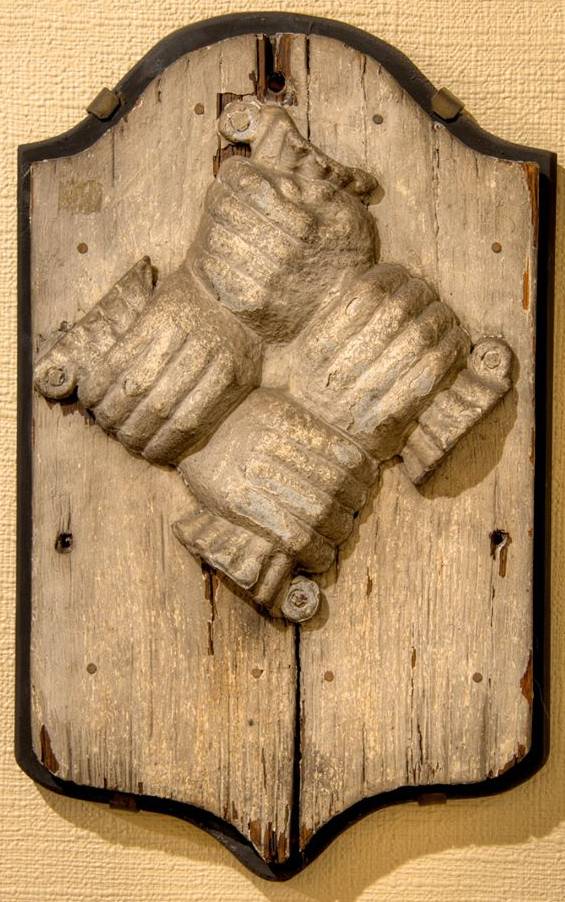
It all started with Benjamin Franklin. When he wasn’t launching the nation’s first circulating library, public hospital, or university, Franklin initiated Philadelphia’s first volunteer fire company in 1736. After two decades of witnessing the devastation caused by fires, he and his fellow volunteers founded The Philadelphia Contributionship in 1752. It is the longest continuously operating insurance company in the nation. Its fire mark featured four clasped, brightly painted hands, symbolizing mutual aid.
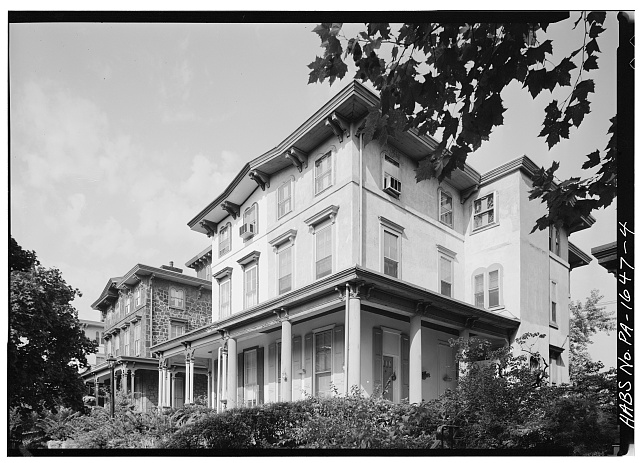
Franklin modeled both the company and its fire mark on a London-based fire insurance firm. The Contributionship is located at 210 S. 4th Street in an 1835 Greek Revival building. The building is now a National Historic Landmark and was designed by Thomas Ustick Walter. The Contributionship maintains a private museum, open by appointment, displaying fire marks and artifacts from Philadelphia’s earliest fire companies.
The Great Fires That Shaped Philadelphia
Despite its many brick homes, Colonial Philadelphia was not immune to fire. One of the city’s most devastating blazes occurred in 1850 at a warehouse near the Vine Street Wharf along the Delaware River. The destruction spread through what is now Northern Liberties. Explosions from chemical stores in the basement hurled burning embers in every direction, putting the entire city at risk. The fire could be seen from 30 miles away. Firefighters arrived from Maryland and New York, and the disaster made national headlines. In total, 100 people were injured, 28 died, and 300 homes were destroyed. This catastrophe ultimately led to the establishment of a paid municipal fire department in 1871.
Why Fire Marks Still Matter Today
By then, fire marks were no longer necessary, which only adds to their allure today. The Contributionship issued them from 1752 through the 1830s and again briefly in the early 20th century. They are still presented to perpetual policyholders and can be seen on many homes in Society Hill.

Where to See Fire Marks in Philadelphia
If you want to explore fire marks up close, whether for yourself or with kids, the best place to start is the Fireman’s Hall Museum at 147 N. 2nd Street, housed in a renovated 1898 firehouse. Opened in 1967, the museum features an impressive collection of fire marks dating from 1752 to 1900, along with horse-drawn fire engines, historic photographs, detailed models, and fire alarm boxes dating back to 1856. After your visit, consider walking through Society Hill with a camera or sketchbook to document the fire marks you discover.

Common Fire Mark Designs You’ll Spot
Below are a few fire mark designs you may spot around the city:
- The Mutual Assurance Company (1784–1996): A small tree, later replaced by a larger tree.
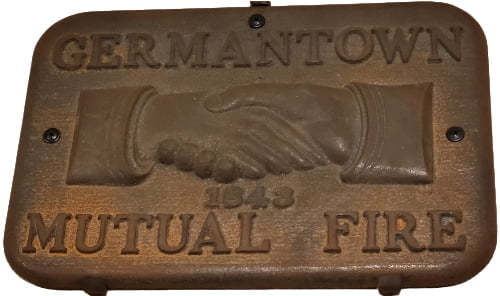
- Mutual Fire Insurance Company of Germantown (1843–Present): Clasped hands with the words “Germantown” and “Mutual Fire.”
- Fire Association of Philadelphia (1817–1958): A fire hydrant with the letters F & A.
- Girard Fire and Marine Insurance Company (1853–1956): A rectangular plate labeled “Girard Ins Co Philadelphia.”
- Lumbermen’s Insurance Company (1873–1950): A diamond-shaped mark framed by four logs with the monogram “L I Co” in the center.
- United Firemen’s Insurance Company (1860–1956): A gilt fire engine with the letters U & F.
- Insurance Company of North America (1792–Present): A gilt eagle with the letters I.N.A.
Collecting Philadelphia Fire Marks
Fire marks remain popular collectibles and meaningful gifts. While the Philadelphia Contributionship does not sell them directly, it donates a limited number each year to the Fireman’s Hall Museum to sell as a fundraiser. If you’re interested in purchasing a contemporary Contributionship fire mark, visit the museum shop and search under “fire marks.”
Original 18th and 19th-century fire marks rarely come on the market, but when they do, they are highly sought after. For those eager to dive deeper, consider connecting with the Fire Mark Circle of America, an organization that brings together collectors and enthusiasts from across the country.