
the secret life of buildings
The Secret Life Of Buildings: Philly’s Marble Stoops



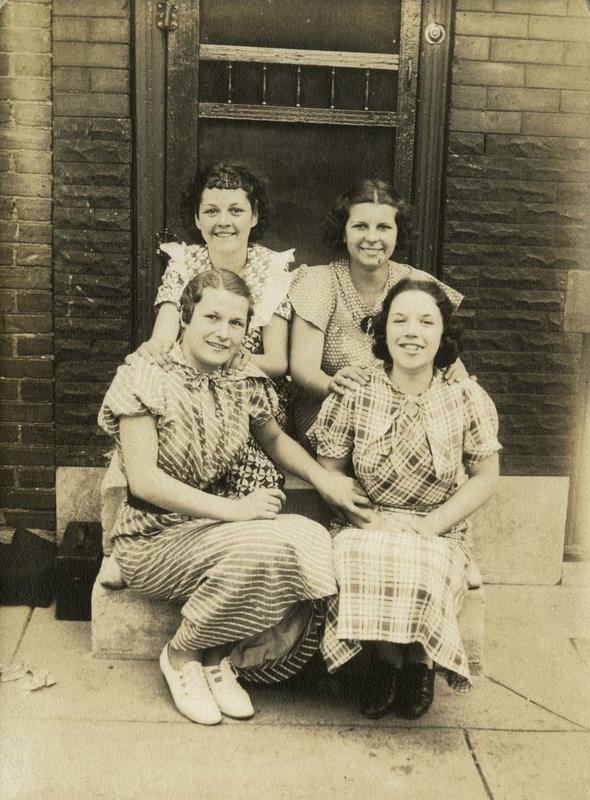
Four young women sitting on a marble stoop, Philadelphia, 1931. Image: Keith, John Frank, 1883-1947, photographer. Library Company of Philadelphia| Print Department, John Frank Keith Photograph Collection.
Although marble steps, or “stoops,” are associated today with modest rowhouses built in the late 19th century, they first appeared in the grand Georgian homes of Philly’s 18th-century elite. A prime example is the Hill-Physick House at 321 S. Fourth St., built in 1786. A stroll along Spruce Street and its side alleys, from Second St. to Broad, reveals a variety of early- and late-19th-century marble stairs on homes of all sizes, from trinities to townhouses and mansions.
When working-class immigrants flooded into the city from the 1890s through the 1930s, the marble steps of newly built rowhouses in South, West, and North Philly conveyed a sense of pride and community. They also provided a place to cool off when summer temperatures turned rowhouses, without cross ventilation, into ovens before the advent of air conditioning. Because family members spent so much time on their steps, they became a social hub where neighbors of all ages, nationalities, and languages mingled, courted, and showed off new babies. They also provided “eyes on the street,” creating a sense of safety. Ultimately, these marble steps were a basic building block of the community.

Library Company of Philadelphia| Print Department, John Frank Keith Photograph Collection

Library Company of Philadelphia| Print Department, John Frank Keith Photograph Collection
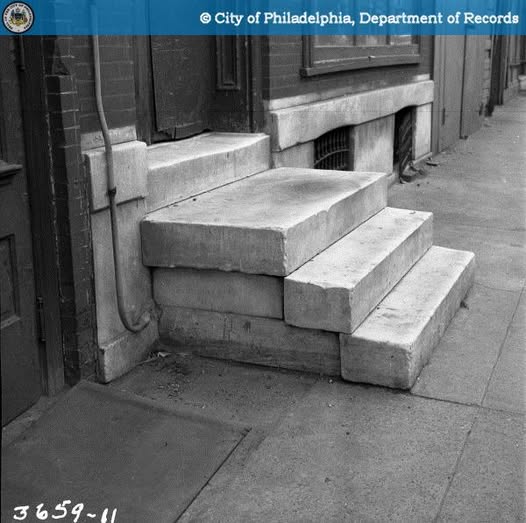
The word stoop comes from the Dutch word stoep, meaning the raised platform at the entrance of a house. In Philadelphia, they range from a single slab of marble to four stairs, sometimes accented with wrought iron or brass railings. So where did all this marble come from? From 1790 to 1860, prized Pennsylvania Blue, or “Clouded,” Marble was quarried in Montgomery and Chester Counties, just 30 miles outside the city. It formed from limestone 450 million years ago and metamorphosed 50 million years ago. Traces of minerals such as magnesium give Pennsylvania marble its blue hue, while graphite produces gray tones.

It was used primarily for monumental public building projects and Greek Revival architecture, including the First Bank of the United States at 120 S. Third St. and the Merchants’ Exchange Building at 143 S. Third St., but it was also a durable regional stone used for rowhouse steps. By the late 1850s, Philadelphia supported about 60 marble-cutting establishments, including large yards and manufacturers near Ridge Avenue. Today, restorations often reuse salvaged slabs from demolished homes.
From 1910 through the 1940s, amateur photographer John Frank Keith focused his lens on working-class men, women, and children posing on marble stoops in South Philly and Kensington. His collection of 250 portraits, held by the Library Company of Philadelphia, reveals a sepia-toned cross-section of people in their Sunday best, cavorting for the camera and documenting everyday life. Some images show up to 24 family members gathered on one set of stairs. Others capture the once-a-week ritual, usually on Saturdays, of women and children cleaning their steps and sidewalks with pride. Known as “cleaning down the block,” it was a communal effort, often accompanied by neighbors chatting and children playing in water from open fire hydrants.
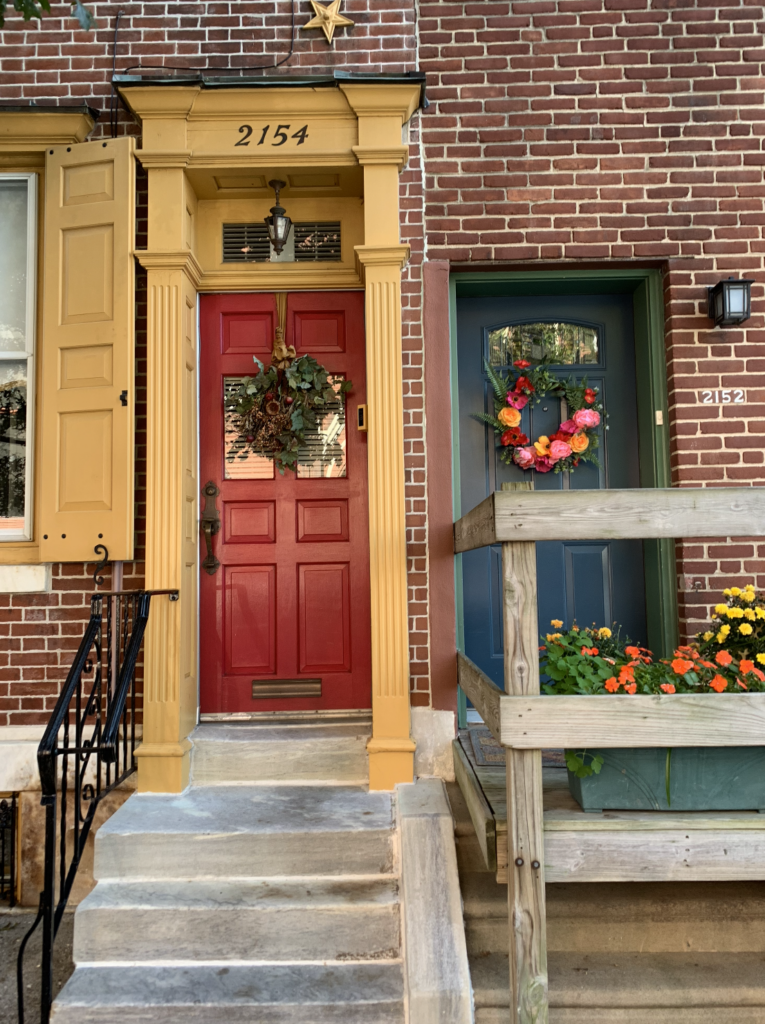
While “cleaning down the block” may no longer be a weekly ritual, you can still keep your marble steps looking their best. Here are some tips on cleaning your marble steps:
Do:
- Use a soft broom to clear away dust and debris.
- Mix 1½ cups distilled water, ⅓ cup rubbing alcohol, and ½ teaspoon mild dish soap.
- Use a microfiber cloth or soft sponge to gently wipe, don’t scrub.
- Rinse with clean water to remove any residue.
- Dry with a clean towel; water spots can stain if left to air dry.
- If your marble looks dull, apply a small amount of marble polishing powder.
Don’t:
- Use “multi-surface” cleaners.
- Don’t scrub with steel wool or hard brushes.
- Use vinegar, lemon juice, bleach, ammonia, and harsh bathroom cleaners.
Sadly, neighborhoods that once held life’s daily moments on front steps can now feel quieter. People retreat into cars, offices, and behind closed doors. Perhaps that’s because many never experienced a block where everyone knew your name, where conversations stretched across stoops, and where community was something you stepped into, not pre-scheduled. These days, unfortunately, the most reliable visitor might sometimes be an Amazon delivery.
However, the stoop is still there, waiting. And it doesn’t take much to bring it back to life. A chair. A conversation. A few minutes at the end of the day. If space allows, add a ceramic or stone planter with seasonal plantings—tulips in spring, geraniums in summer, mums in fall, winter kale in the colder months. Small gestures, maybe, but they signal something bigger: presence.
Marble steps were never just an architectural detail. They were an invitation to gather, to linger, to belong. And they still can be.
This article is part of a series titled “The Secret Life of Buildings” where we cover the history and architecture behind Philadelphia’s storied buildings. We’ve written about row house styles, courtyards, and star bolts, among other topics. What else would you like to learn about? Follow us and message us on Facebook or Instagram to let us know!