
architecture
The Secret Life of Buildings: The Wanamaker Building



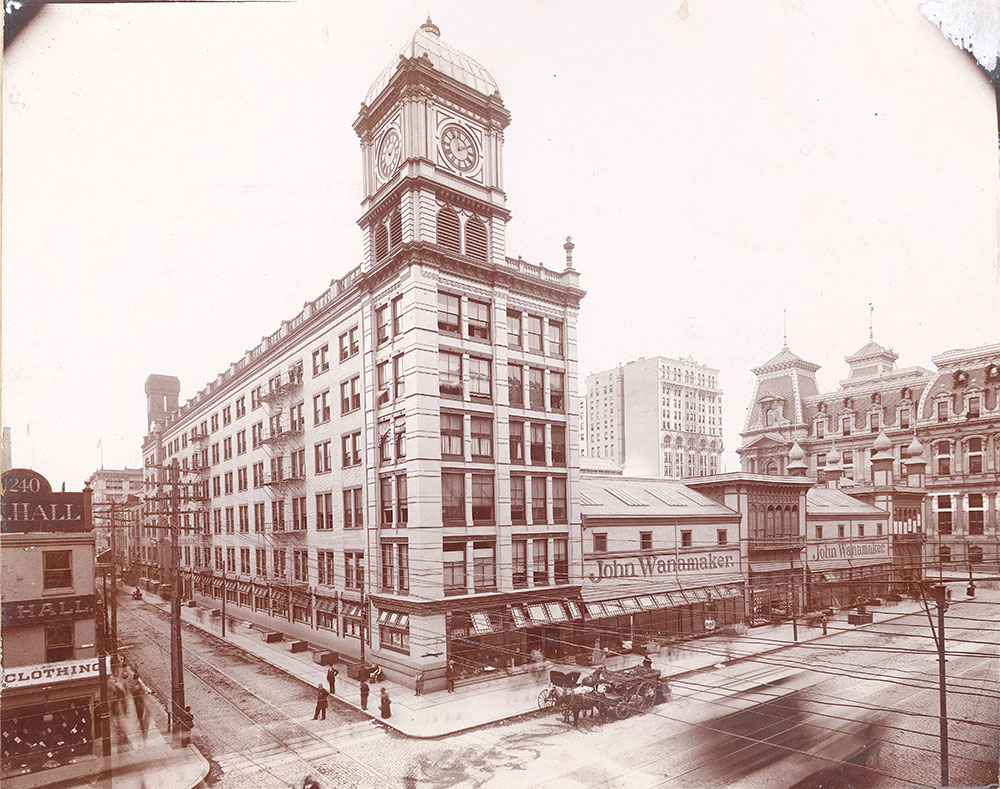
Wanamaker, 1900. Image: Free Library Picture & Print Collection
Everyone has their own memories of the Wanamaker Building: riding the monorail above the toy department, meeting friends at the Eagle, dining in the Crystal Tea Room, or gazing up in awe at the Christmas Light Show in the Grand Court. While many of Philadelphia’s department stores have come and gone, the City still holds an unusually deep emotional stake in the future of Wanamaker’s. To understand why, we traveled back in time.

Rags to Riches
John Wanamaker (1838–1922) was born into a family of brick makers in the Gray’s Ferry section of South Philadelphia. He left school at 14 to work as an errand boy, eventually earning a higher-paying position at a men’s clothing store. His talent for retail quickly became apparent. At 22, newly married, he went into business with his older brother, opening Oak Hall at 6th and Market Streets. Within a decade, the store was generating $2,085,528 annually, over $54 million today, an extraordinary fortune in the Gilded Age.

After his brother’s death, Wanamaker used his profits to purchase the abandoned Pennsylvania Railroad Freight Depot at 13th & Market. He transformed the two-story Byzantine-style terminal into the John Wanamaker Grand Depot, initially dedicated to menswear. Within a year, he expanded into women’s clothing and dry goods, creating Philadelphia’s first true department store and one of the earliest in the nation.

A Retail Revolutionary
Wanamaker changed American retail forever. His store was the first to guarantee quality in print, introduce cash-refund returns, and offer a full-service restaurant inside a department store. He pioneered the modern price tag, making haggling obsolete, and became the first major retailer to provide employee benefits such as free medical care, recreational facilities, profit-sharing, and pension plans. The Grand Depot was also the first department store with electric lights, a telephone, and pneumatic tubes to transport cash and receipts.

In 1902, he commissioned Chicago architect Daniel H. Burnham, known for Philadelphia’s Land Title Building and a leading proponent of the Beaux-Arts style, to design the largest department store in America. Completed in 1911, the Wanamaker Building spanned an entire city block from Market to Chestnut Streets, with twelve stories above ground, three below, and more than 100 specialized departments. Its majestic central court rivaled Parisian retail palaces like Galeries Lafayette. That was intentional: Wanamaker sought to introduce Philadelphians to the European concept of le grand magasin, sending his buyers abroad to bring back the latest fashions.
The Eagle and the Organ
Among the building’s most iconic features are the 2,500-pound bronze eagle and the massive pipe organ, both purchased from the 1904 St. Louis World’s Fair. The Wanamaker Organ debuted in 1911 and soon became a cultural phenomenon. After-hours concerts featuring Leopold Stokowski and the Philadelphia Orchestra drew crowds of up to 15,000. With 10,000 pipes at the time, later expanded to more than 28,000, it was the largest organ in the world. Beginning in 1922, the store even broadcast organ concerts on the radio.

Reinvention and Resilience
Wanamaker’s branch stores of the 1950s and ’60s never matched the splendor of the Philadelphia flagship and were quickly forgotten, converted into chain retailers after the brand’s decline. Yet Philadelphians’ devotion to the original building never wavered, through its transitions to Strawbridge, Hecht’s, Lord & Taylor, and then Macy’s, through decades of reconfigured retail floors and added office space. No matter the name, people still “met at the Eagle,” watched the Holiday Light Show, and referred to the building simply as Wanamaker’s.
The organ’s future has always been safeguarded: as a National Historic Landmark, it cannot be removed or dismantled. Most recently, the Philadelphia Visitor Center, TF Cornerstone (the building’s new owner), and the Friends of the Wanamaker Organ raised $350,000 to ensure the return of the beloved Holiday Light Show.

TF Cornerstone plans to transform the Wanamaker Building into 600 apartments with updated retail, office space, and dining. Whatever the future brings, two constants remain: the Eagle and the Wanamaker Light Show, featuring the legendary organ. The free show runs every hour on the half-hour from Nov. 28 to Dec. 24.

This article is part of a series titled “The Secret Life of Buildings” where we write about the history and architecture behind Philadelphia’s buildings. We’ve covered common Philadelphia brick styles, trinity homes, and star bolts, among other topics. What else would you like to learn about? Follow us and DM us on Facebook or Instagram to let us know!