
architecture
The Secret Life of Buildings: Italianate Style in Philadelphia



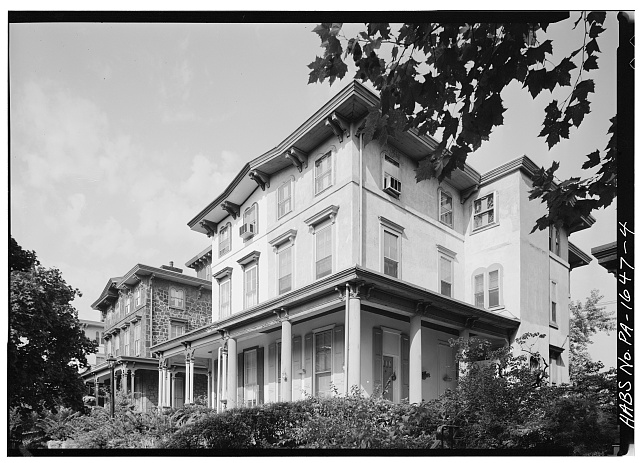
Woodland Terrace. Image: Public Domain.
Rarely is an architectural style credited to one person, but when it comes to Philadelphia’s Italianate homes and buildings, Samuel Sloan literally wrote the book. After working as a carpenter in the 1830s & 40s on projects such as the Eastern State Penitentiary, Sloan eventually transitioned to architecture in 1850. His first commission was Bartram Hall, an Italianate villa in the Norman style for a wealthy industrialist on the site of Bartram’s Gardens. Bartram Hall, which burned down in 1896, was one of the earliest examples of the Italianate style for a domestic building in the nation.
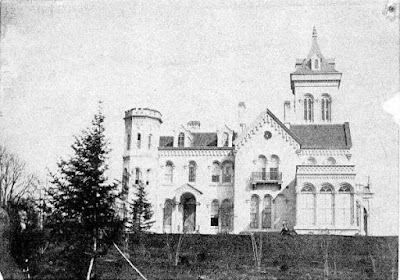
Like most styles adopted by American architects, the Italianate style, with elements from the Italian Renaissance, originated in Great Britain around 50 years before it reached our shores. The key elements included arched windows, towers, flat roofs, cupolas, and balustrades. It offered a romantic Tuscan villa aesthetic that could be adapted to grand mansions and modest row homes alike. This came as an architectural palette cleanser following the classicism of the Federal style.
Sloan was considered Philadelphia’s most important and prolific architect of his time and a trailblazer of Victorian Italianate design. Throughout the 1850-60s, he designed Italianate homes and public buildings all over the City, State, and as far south as Raleigh, NC. His work includes the home of French-born architect Philippe Cret, 516 Woodland Terrace; Hamilton Terrace, 500-512 S 41st St.; and 4012-4014 Pine Street.
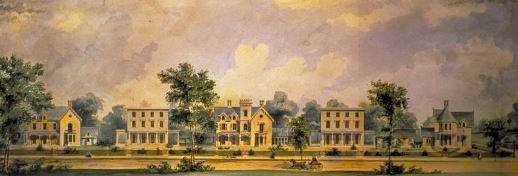
West Philly was ripe for development due to the expansion of trolley lines, which turned it into a “Streetcar Suburb.” Philadelphia developer Charles Leslie commissioned Sloan to design 20 impressive Italianate twin mansions on Woodland Terrace in West Philly to attract affluent and middle-class homeowners near the intersection of Baltimore Avenue and 40th Street. It was listed on the National Register of Historic Places in 1972.
Sloan also designed a multitude of Italianate schools, churches, courthouses, hospitals, and mental institutions, including the 1855 Courthouse of Lancaster County, PA. Unfortunately, one of Sloan’s most significant commissions, the Joseph Harrison House, 221-225 South 18th Street, which took up an entire block on Rittenhouse Square, was demolished in the 1920s.

When we say Sloan wrote the book on Italianate design, we aren’t speaking figuratively. In addition to being an architect, Sloan was a best-selling author of architecture books, journals, and magazine articles. He even contributed his architectural designs to Godey’s Ladies’ Book, the mid-19th century equivalent of Better Homes & Gardens.
The Civil War brought Sloan’s commissions to a halt. His most famous building, the octagonal mansion, Longwood, in Natchez, Miss., was left unfinished. While the War was a death blow to the economy for many, it created a new demand for those who got rich supplying the Union Army. They wanted more ornate, imposing residential architecture, with stricter reliance on European models. So strict, they moved castles from Wales to the Main Line, brick by brick. Goodbye Tuscan villas, hello castles of the Gilded Age! Case in point, the 110-room Neo-Classical Lynnewood Hall in Elkins Park, designed by Horace Trumbauer in 1897.
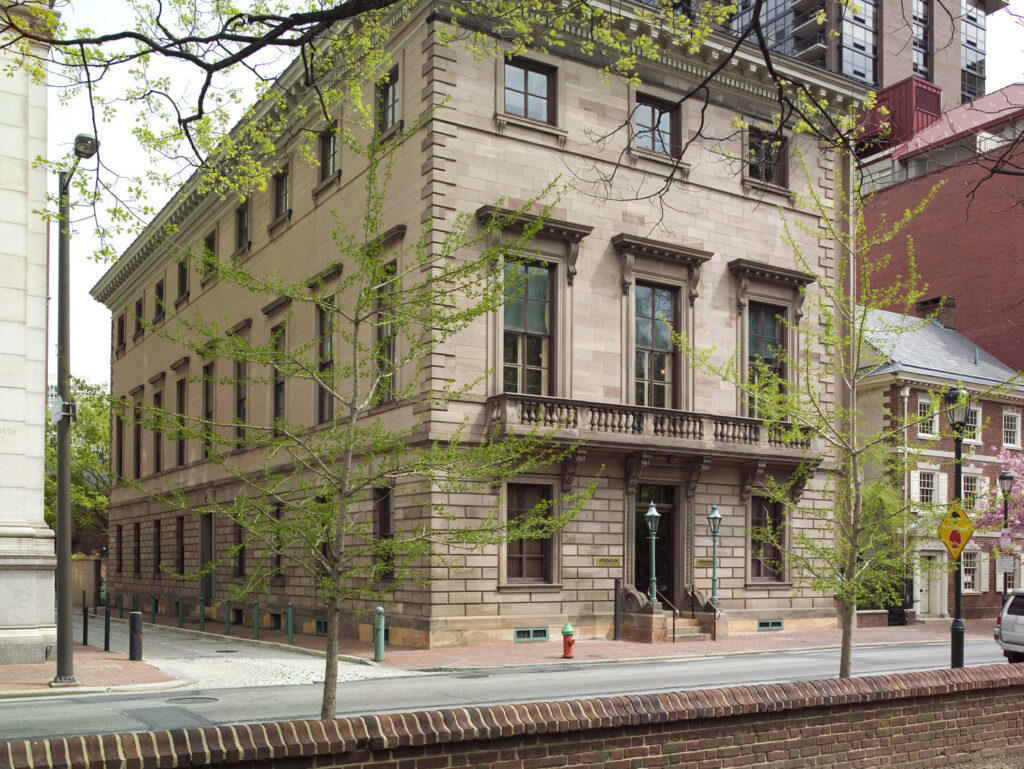
Fortunately, historic preservation has maintained many excellent examples of Italianate design, enough to create your own walking tour in Center City, West Philly, or Chestnut Hill. Check out 1122-24 Spruce, built in the 1850’s as a Presbyterian training school with triple-arched windows; an 1860s townhouse at 1805 Spruce; and the charming 1856 Pompadour House, 2103 Pine, featuring a second-story balustrade. On Locust Street, 1618, 1620, and 1622 are considered to be excellent examples of Italianate style. 1822 Chestnut, the historic Elon Dunbar House, was built in 1858 by a wealthy merchant. While you are in the neighborhood, note the handsome Italianate row houses along the 2000 block of Walnut Street. Another example of Italianate Revival style can be found on the regal Athenaeum, 219 S. 6th S, designed by John Notman.
In West Philly, in addition to the locations mentioned earlier in this article, consider the Italianate mansion, which is now the Restaurant School at Walnut Hill College, 42nd & Walnut; 223 S 42nd St built in 1860; and 3726 Barring St.
Up for a drive? Chestnut Hill has an eye-popping selection of well-maintained Italianate mansions. They include: 5 East Chestnut Hill Ave., built in 1856; an 1860 mansion at 400 East Evergreen Avenue; a 1857 Wissahickon Schist Italianate mansion at 208-210 Rex Ave.; and an 1847 mansion and cottage, 30 W. Bells Mill Rd, hidden from sight in historic Wissahickon Valley Park.
In retrospect, all of Philadelphia’s architectural styles reflect the politics, economics, and culture of their time. Italianate architecture expressed the aspirations of a growing professional and merchant class who were eager to embrace a more romantic style of life in the new commuter suburbs. Luckily for us, their yearning for mid-19th century Tuscan villas continues to enhance our City today.